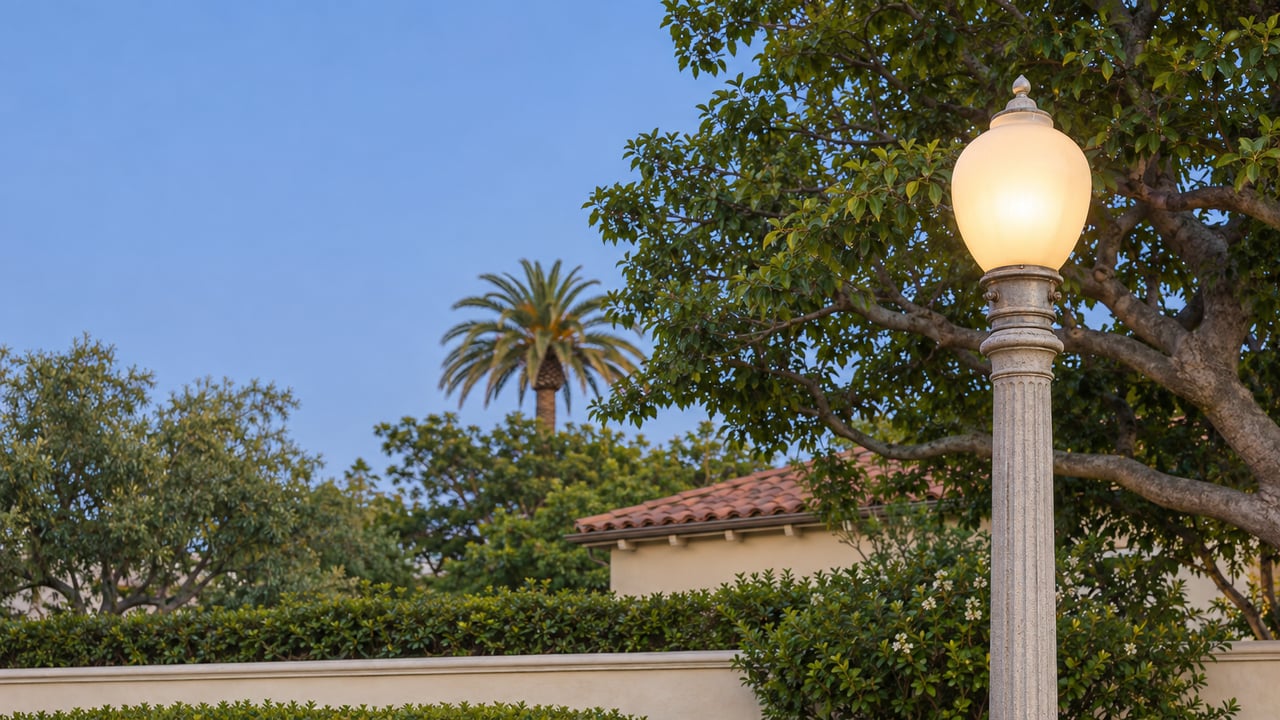
Thirty-seven metal lampposts still line Belmont Avenue between Livingston Drive and Third Street. The Belmont Heights Community Association has set a $36,500 goal to restore them, and in mid-November its donation page showed $30,760 raised toward it. The City of Long Beach has said it can't fund the work, so the money is coming from neighbors. Street lights were also part of how Belmont Heights came into Long Beach. In 1909 the neighborhood gave up being its own city, and Long Beach promised it police and fire protection, street maintenance and street lights.
A Town That Lasted About a Year
The neighborhood began as the Mira Mar tract, which real estate agents Frank Shaw and H. S. Gundry opened in 1901 on a bluff above Devil's Gate, the rock formation later removed for the Belmont Pier. Local historian Claudine Burnett, writing about the City of Belmont Heights, says the land was too far from Pine Avenue to sell until the Pacific Electric arrived. By 1905 a Red Car came every half hour and reached downtown in eight minutes, and Mira Mar lots began to sell. In January 1905, 120 lots went on the market at $500 to $1,250 each, and the tract had no lot narrower than 50 feet. In 1906 Frank Strong of the F. W. Sterns company opened an adjacent tract called Belmont Heights. By 1908 that name covered the whole area.
The new residents wanted city services, and they split over how to get them. Some wanted to join Long Beach for its street improvements, fire and police protection and street lighting. Others wanted their own city so they could decide how their tax money was spent. Burnett writes that some residents already suspected liquor was the real reason behind the push for independence. Cityhood passed 59 to 33 in October 1908. The first board of trustees lived at addresses a resident today would recognize. Joseph W. Ray lived at 3410 E. 7th St., and Henry W. Bassett lived at Ximeno and Vermont. Los Angeles County's records date the incorporation to Oct. 9, 1908.
Long Beach did not take the split well. According to Burnett, critics nicknamed the new town "Spite City." Within weeks its trustees approved a franchise for a baseball and amusement park meant to compete with the Pike. Long Beach answered by annexing most of the Belmont waterfront. The trustees then passed an ordinance allowing a wholesale liquor house in town, and the town's temperance-minded residents took that as proof of what they had suspected.
What followed moved quickly for such a small place. A mass meeting on Jan. 18, 1909 condemned the trustees. A petition for disincorporation went to the city clerk carrying 64 signatures, and the dispute reached the California Supreme Court. Trustees Gould and Van Deventer went into hiding to avoid the court's order to call an election, and they gave in on Oct. 9, 1909. In the consolidation vote on Nov. 9, Belmont Heights voted 87 to 47 to join Long Beach, and the combined total was 910 to 79. The county lists the consolidation as final on Nov. 24, 1909, 117 years ago this week.
Burnett writes that the liquor house closed and Long Beach provided the police and fire protection, street lights and maintenance it had promised. Residents were still angry about losing the waterfront, so Long Beach also passed a bond for a new pier at Devil's Gate. That first pier was built in 1915 near 39th Place, and the City says the concrete pier standing there now dates to 1965.
Belmont Avenue Got Its Own Lights in 1923
The lampposts on Belmont Avenue came 14 years after consolidation, and a single resident pushed for them. According to a 2025 BHCA newsletter story, H. M. Porteous of 264 Belmont Avenue advocated for the lights and for paving the street. The 39 posts have lit the avenue between Livingston and Third Street since 1923.
1923 was a busy building year in this part of Long Beach. That same year, builders Boland & Smith put 30 small bungalows on Eliot Lane, on a former alley between Colorado Street and Third Street, as the Press-Telegram reported. The City says the oldest homes in the Belmont Heights historic district date to 1905 and that construction peaked from 1918 to 1923. The lampposts went up in the last year of that peak.
Residents have stepped in to protect the posts before. In 1971 the city planned to replace them, and resident Ed Sheridan argued for keeping them. In 2010 neighbors got together and repainted every post. For readers who know the district's rules mainly from the contributing and non-contributing split, the lampposts are a different case. They belong to the street, and their upkeep has depended on whoever lives on it.
The 2025 Losses Restarted the Effort
In 2025 the city removed two of the posts. One had been hit by a car and the other had rusted through. The BHCA story says the other 37 still worked but showed significant rust. A teenage Eagle Scout candidate who grew up on Belmont Avenue chose the posts for his service project. He worked with Mark Roberts of Public Works Traffic Operations to make sure the two replacements would be metal and close to the original design. Councilmember Kristina Duggan and her office helped him reach the right people at Public Works.
By late January 2026, the BHCA reported that the City had received replica replacements for the two destroyed posts and that they were waiting to be installed. Repainting and restoring the other 37 was estimated at $36,500. The City could not fund that work, and Duggan offered to try to help pay the cost of a landmark application. According to the same update, landmark status also matters for grants, because the grants the project wants to apply for require it.
On June 26 the association posted a petition asking the City to recognize the lampposts, preserve the existing posts wherever feasible, explore landmark designation and work with neighbors on a practical restoration plan.
Over the summer, the campaign also became a street event. The "Lighting the Way" block party was held on Saturday, Aug. 15, from noon to 4 p.m. on Belmont Avenue between Vista Street and Third Street. Afterward, the association described the turnout as overwhelming.
Where the Fundraising Stands This Fall
In September the BHCA joined Long Beach Gives for the first time. It asked for donations for two projects, the lampposts and its 2027 Make a Difference Day. The lamppost campaign page explains the plan in terms of the City's budget. It says the City faces a significant fiscal deficit, so the neighborhood will restore the posts in phases, starting with the ones in the worst shape, and will keep asking the City to cover the rest once its budget recovers. The association surveyed all 37 remaining posts. It found three in critical need of repair and six more with significant rust and peeling paint. It puts full restoration at about $900 per post.
The two donation pages are tracked separately. In mid-November, the BHCA's main donation page showed $30,760 of its $36,500 goal, about 84 percent. The Long Beach Gives page showed $820 from five donors toward its own $9,000 goal. At $900 a post, the three posts in critical condition would cost about $2,700 and the nine in the worst shape about $8,100. Those figures roughly match the $9,000 Long Beach Gives target.
Walking the Story From Livingston to the Pier
The 1909 story is easy to see on foot. Start at Livingston Drive and walk north on Belmont Avenue toward Third Street. It is the same stretch where the 39 posts went up in 1923, and the survey's three critical posts and six rusted ones are somewhere along it. The block between Vista Street and Third Street is where the August block party was held. Then head south to Ocean Boulevard at 39th Place. That is where Long Beach built the 1915 pier it promised Belmont Heights for joining the city. The pier there today is the concrete one from 1965. For a longer walk, the Broadway block is a few minutes inland.
The trustees' addresses still work as directions. Joseph W. Ray lived at 3410 E. 7th St. and Henry W. Bassett at Ximeno and Vermont, the mayor who, according to Burnett, favored liquor licenses. In 1909 those corners were part of a separate city. Today they are Long Beach addresses a few blocks from the lampposts the neighborhood is raising money to restore. Anyone who wants to help can find both donation pages through the Belmont Heights Community Association.
If you own a home on one of these blocks, from Belmont Avenue's lamplit stretch to the streets where the 1908 trustees once lived, and want to know what it is worth today, Cynthia Voss and Nathan Walter can prepare a free home valuation and talk through what they are seeing in Belmont Heights.