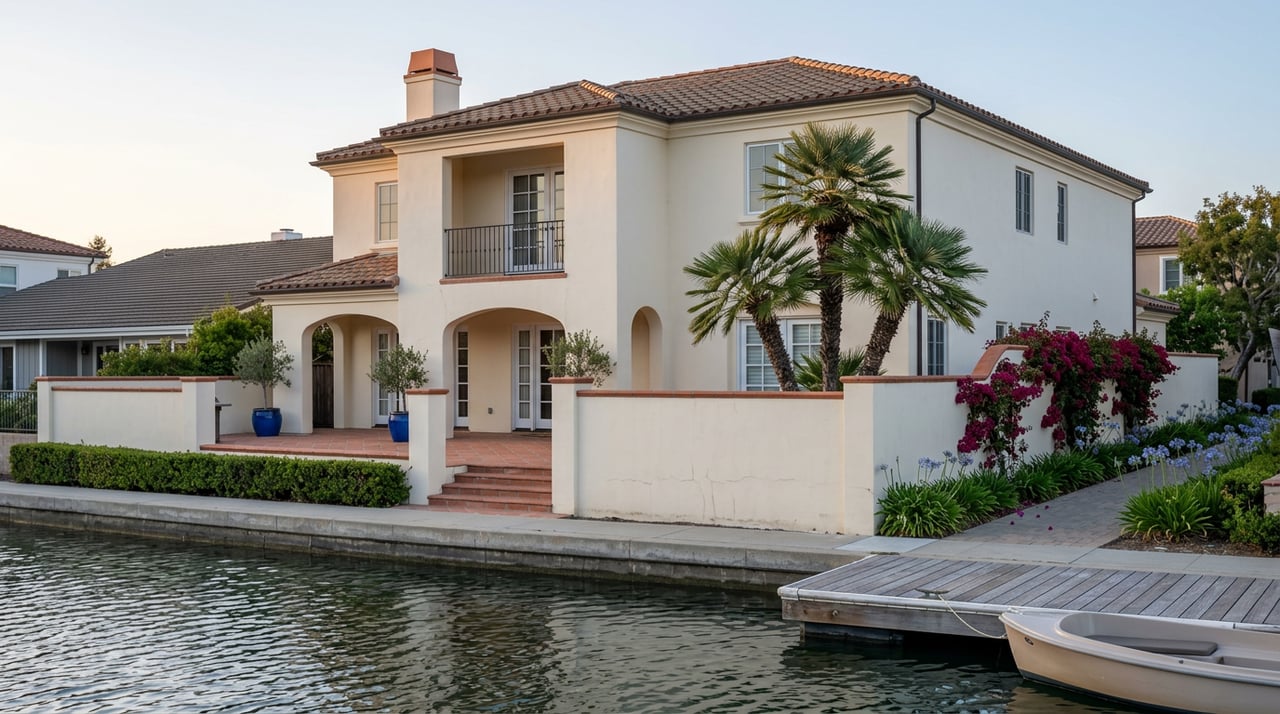
Walk the Rivo Alto Canal loop at high tide and you can watch the story change under your feet. In front of one home, the sidewalk sits dry and level, the concrete new, the guardrail crisp. Fifty feet later, in front of the next home, seawater is creeping up through cracks in the old wall and pooling across the walkway. Same canal. Same view. Same general price bracket on paper. Completely different piece of infrastructure holding the water back.
That gap between what a listing shows you and what the seawall behind it is actually doing is the detail worth understanding before you write an offer on Naples Island, and it is the detail that almost never makes it into a conversation about median price.
Two of Six
The LB Post reported that the city of Long Beach found the seawall system around Naples Island in a state of significant disrepair back in 2009, after divers and landside inspectors traced cracking and corroded rebar to decades of wave erosion. The fix was broken into six phases. Phase one wrapped up in October 2015, rebuilding sections of Rivo Alto Canal between the Ravenna Drive Bridge and The Toledo bridge with a new steel sheet-pile wall, sidewalks, and landscaping. Phase two, awarded to Reyes Construction in 2019, covered another 2,148 linear feet along The Colonnade, the south and eastern end of Treasure Island, and the western end of the Naples Peninsula.
That leaves four phases still waiting on funding, and the remaining sections are not evenly distributed. City reporting has flagged the northwest stretch of Rivo Alto Canal as especially fraught, citing deterioration and scouring at the base of the walls. The LB Post quoted a member of the Naples Island Improvement Association describing the contrast between the finished and unfinished sections:
"That's the whole point. The seawall is supposed to keep the seawater out, and it doesn't."
Two of six phases done means four remain, and nobody involved has published a start date for the next one.
The Bill Nobody Has Written Yet
The reason the remaining phases are stuck is money. Long Beach put the cost to finish the job at $125 million, and the city's Tidelands Fund, historically fed by oil revenue, does not have it. With state and federal aid uncertain, city officials floated the idea of a homeowner-funded bond as one option among several. Spread across the roughly 1,572 parcels that sit along the seawall system, that pencils out to about $5,100 per property per year. Narrowed to just the 174 parcels fronting the unrepaired sections, the number jumps to roughly $48,000 per property per year.
Councilmember Kristina Duggan, who represents the district that includes Naples, called the higher figure "laughable" when it was floated, pointing out what it would do to homeowners on fixed incomes. LAist reported that any assessment along these lines would also require a two-thirds vote of the affected property owners before it could move forward, which means this isn't a fee the city can simply impose. It is a decision Naples Island residents, and future residents, would have to make together.
Where the Story Stands This Year
None of this has been resolved. When Long Beach adopted its Fiscal Year 2026 budget in September 2025, the seawall line item was modest next to the scale of the problem: $2 million allocated for Naples Seawalls tiebacks, including work on the Sorrento Trail and related permitting requirements. Tiebacks are a reinforcement measure, not a replacement, and the budget treats them that way, a way to shore up what already exists while phases three through six sit unfunded. A homeowner who closes on a canal-front property this year is buying into a question the city itself has not answered.
The Dock Detail With an Expiration Date
There is a second piece of this that shows up at the waterline rather than in a budget document. As part of the Coastal Commission permit that governs the seawall repairs, dock floats in Rivo Alto Canal and Naples Canal are restricted to six feet in width, measured from the inland edge of the float to the seaward edge. Existing docks are grandfathered until they are replaced or substantially repaired, at which point they have to come into compliance, and the city has set a hard deadline of December 31, 2028 for that transition.
If you are considering a home with an older, wider dock float, that restriction is worth understanding before closing, not after. A dock that needs rebuilding in a few years may come back narrower than the one you toured.
What This Means for the Number You See Online
Sale prices on Naples Island have ranged widely over the past year, from homes in the low seven figures on interior lots to canal and bay-front estates well north of $10 million, with a typical sale landing under $2 million as of mid-2026. That range gets explained, correctly, by water frontage, dock access, and lot position. What it does not capture is which side of the seawall repair schedule a given property sits on.
Two homes with nearly identical frontage, both on Rivo Alto Canal, can carry very different exposure depending on whether they sit behind a wall completed in 2015 or one still waiting for phase three. The listing price reflects the view; seawall condition is another factor a buyer may want to consider.
Before You Write an Offer on the Water
A few questions worth asking before you get attached to a specific address:
- Which seawall phase covers this property, and was it completed, or is it in the unfunded portion of the project?
- Has the seller, or the Naples Island Improvement Association, received any recent city correspondence about seawall funding or a proposed assessment?
- What are the dimensions of the existing dock float, and would it need modification to meet the six-foot standard if it were ever replaced or substantially repaired?
- Does the property show visible signs the city has flagged elsewhere, such as cracking at the base of the wall or regular high-tide flooding on the adjacent sidewalk?
- What does insurance currently cost on this specific stretch of canal, and has that carrier flagged the seawall condition in underwriting?
They come from knowing where the project stands, which is exactly the kind of local knowledge that matters more here than almost anywhere else in Long Beach.
A Few Common Questions
What is happening with funding for the remaining phases? The city is still looking for ways to fund the remaining phases.
Does this affect the whole island or just certain streets? It affects specific stretches, not the entire perimeter. Phases one and two are done. The remaining risk concentrates on the sections still waiting for phase three and beyond, including parts of the northwest Rivo Alto Canal.
Could this delay a sale? It shouldn't, if it's addressed early. Buyers who ask about seawall status upfront, as part of their due diligence alongside inspection, can move through escrow without surprises. The homes that run into trouble are usually the ones where the question never gets asked until late in the process.
Naples Island is still one of the most sought-after addresses in Long Beach, and that is not changing. What is changing is how much a buyer needs to know before treating a canal-front listing like any other coastal purchase. The wall behind the house is part of the deal, whether or not anyone brings it up.
If you are weighing a purchase or a sale on the island and want a clear-eyed read on a specific address, including where it sits relative to the seawall phases, Cynthia Voss has spent decades working these blocks and can walk you through what to check before you write an offer. Request a free home valuation to start that conversation.
This article is general information, not legal, tax or financial advice. Consult a qualified professional about your situation.